Reptiles ·
How big a vivarium does a bearded dragon need? Measure your setup
A bearded dragon warms up by walking to a hot spot and cools down by walking away, so the length of its viv matters more than most people think.
Type in your dragon's length and your viv's measurements and get a green, yellow or red check on length, depth, height and lamp distance. The RSPCA's adult minimum is 120 x 60 x 60 cm. Always ask a reptile vet about health worries.
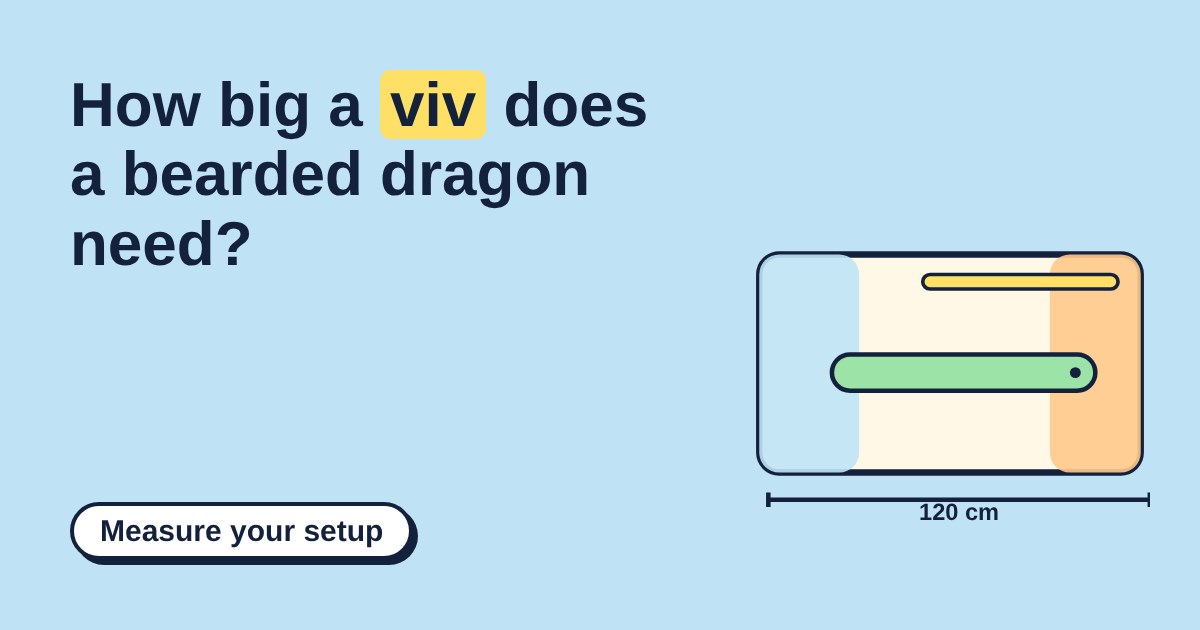
A bearded dragon needs room to travel
A bearded dragon is a desert lizard, and it can't warm itself from the inside. It warms up by walking to a hot, bright spot and cools down by walking away again. That only works if the enclosure (a vivarium, or "viv") is long enough to hold a real hot end and a real cool end, with space in between.
The RSPCA says the minimum for one adult is 120 cm long, 60 cm deep and 60 cm high. A vet hospital's handout (SASH) gives a handy rule for growing dragons: the floor should be at least four times the dragon's length, so a 60 cm dragon needs a floor of about 240 x 120 cm. Put in your own measurements below and see how your setup compares.
Why bigger is better
A small viv isn't just boring. Heat and light are packed into a tiny space, so there is no cool end to escape to. The dragon can't pick the temperature it needs, and that's the whole point of the setup. A longer viv also lets you run the UVB tube (the special light that lets a dragon make vitamin D) over about half the length, so there is a bright zone and a shady zone.
The RSPCA lists the numbers a good viv should reach: a hot basking end of 38-42 °C, a cool end of 22-26 °C, and nights that don't drop below 20-22 °C. The SASH handout gives slightly different numbers (a basking spot around 38 °C, and a night low of about 23-24 °C). When sources differ by a few degrees, it's a sign to measure and ask a reptile vet, not to guess.
One dragon, one viv
Both the RSPCA and the SASH handout say it is best to house bearded dragons separately. They are territorial: males chase off other males, and females in groups can fight and injure each other. A bigger viv doesn't fix that, so plan the space for one dragon.
What goes inside
- A hide at each end, so the dragon can feel safe whether it is warm or cool.
- Climbing stones or branches, with the top of the basking spot well below the lamp.
- A digging box at the cool end, which also matters for females laying eggs.
- A thermometer at each end, set at the height where the dragon sits. Thermostats aren't always accurate, so check readings every day.
- A timer for 12 hours of light and 12 hours of dark.
Keep the viv away from a window, because glass blocks UVB. Avoid loose "calci-sand" and loose bark or wood chips as flooring; the RSPCA warns they can be swallowed and cause blockages. UVB tubes fade over time, so follow the maker's replacement schedule.
Measure the viv, measure the dragon, and give it at least 120 x 60 x 60 cm, and more as it grows.
Signs to ask a vet about
A reptile vet is the right person for health worries. Low UVB can lead to metabolic bone disease, where bones weaken; signs include muscle twitching, swollen legs and fragile bones. Also call a vet about weight loss, odd droppings, a dragon that stops eating, or a female who may be egg-bound (a serious emergency). It's also worth booking a check with a reptile vet soon after getting a new dragon.
Thinking of getting a dragon? Check reptile rescues and welfare groups first.