Birds ·
What is your cockatiel telling you? Read the crest and the body
A cockatiel talks all day with its body, and the crest is only one word in the sentence. Tap a signal, from a crest straight up to a wiggling tail, flat crest, pinning eyes or quivering wings, and see what it often means and what to do next.
Read two or three clues together, learn your own bird's normal, back off kindly when it is scared, and call an avian vet if it sits fluffed up and quiet.
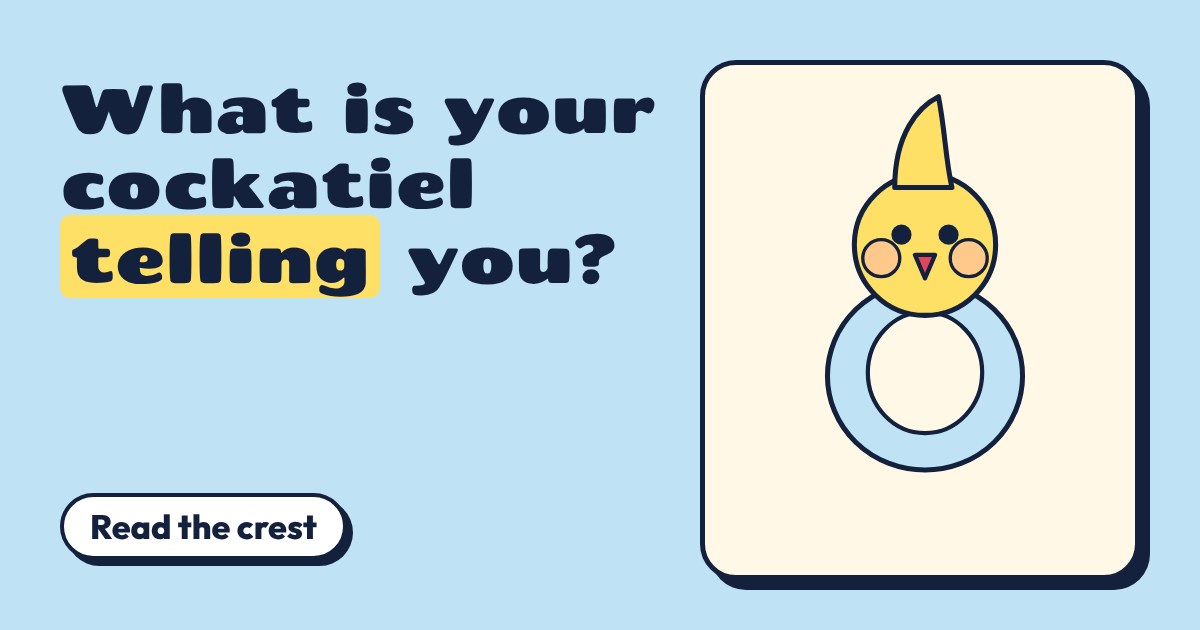
A cockatiel cannot tell you how it feels, but it talks all day with its body. The most famous clue is the crest, the feather tuft on top of its head, though the crest is only one word in a longer sentence. Read it together with the eyes, tail, wings and beak and you will soon know when your bird is chilled out, curious, cross or scared.
Tap a signal, see what it often means
Pick a signal below. The bird changes its crest to match, and the card tells you what the signal usually means and what to do next.
Why one signal is never enough
A raised crest can mean "ooh, what's that?" or "I'm not sure about this", and the crest alone cannot tell them apart. The body does. A bird that leans in with smooth feathers is curious. A bird that leans back with a stiff body and quivering wings is worried. Think of the crest as the volume knob and the body as the tune.
Read the whole bird: crest, eyes, tail, wings, beak. Two or three clues that agree beat one clue on its own.
Learn your own bird's normal
Every cockatiel has its own style. Some stand with a half crest all day, some pin their eyes at the sight of millet. For a few days, just watch and note what your bird looks like when it is plainly happy: eating, preening, chatting. That is its baseline. Anything that departs from it, such as a flat crest all day in a bird that used to sing, is worth noticing.
What to do when your bird is cross or scared
Back off, slowly. Do not chase, grab, shout or tell the bird off. Fear grows when it is pushed, and punishment teaches a bird to skip the polite warning and go straight to biting. Instead, give it space, keep sessions short, and pay for calm behaviour: a treat at a distance, a quiet word, a pause. Over a few weeks the warnings usually become rarer because the bird learns that you listen.
When body language means "call a vet"
Birds hide weakness, because in the wild a sick bird is an easy target. So subtle changes matter. Persistent fluffed-up feathers with sleepiness, sitting on the cage floor, a tail that bobs with each breath, eating less, or unusual droppings are reasons to call an avian or exotic-pet vet promptly. Do not wait for it to pass and do not give medicine from the cupboard: only a vet can say what is wrong and what is safe.