Why is your older cat missing the litter tray? Check the fit, then the vet
When an older cat starts missing the litter tray, the cause is either a tray that no longer fits stiff joints or a health problem a vet needs to see. This guide helps you tell what to adjust and when to ring the vet.
Enter your cat's length and tick what you notice to get a minimum tray size, a placement plan and clear vet flags, including the signs that mean an emergency.
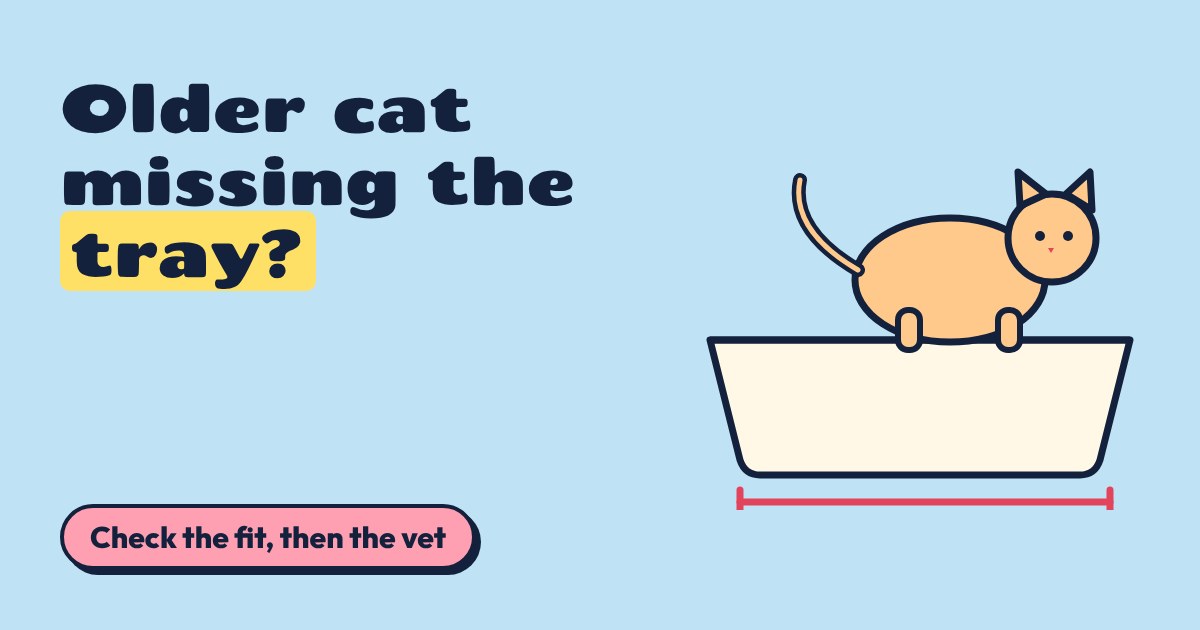
Older cats still want a toilet that fits
A cat who has used the same tray for ten years can suddenly start missing it. Sometimes the cause is the tray itself: a rim that is now a climb for stiff hips, a box that feels cramped, or a spot that is too far from where your cat spends the day. Often, though, the cause is a health problem, and a change in toilet habits is one of the main ways a cat tells us something is wrong.
So this guide does two jobs. It helps you make the tray easier to use, and it tells you when the right move is a call to your vet instead of a new tray.
A new toilet habit in an older cat is a reason to phone the vet first, and to adjust the tray second.
Check the tray and your cat's checklist
Enter your cat's length, then tick what you notice. The result card gives a minimum tray size and the changes that fit your answers. It is a planning aid, not a diagnosis.
Why a rim becomes a problem
Many older cats have sore joints, and arthritis is common in cats, even though cats hide it well. Cats Protection's behaviour writer advises a large tray with a low entrance for arthritic cats. The University of Illinois vet hospital suggests the same, and notes you can cut down one side of a plastic storage box, as long as you check the cut edge is smooth and cover any rough spots.
A cat that perches on the edge, scratches at the wall, or stops covering is often telling you the box is awkward. Do not scold; a cat that is punished for toileting just learns to hide where it goes. Fix the setup instead.
Plan the spots
- One tray per cat, plus one extra, in different places. It keeps a free, unguarded option open.
- Put one on every floor your cat uses, and one on the floor where your older cat spends most of the day.
- Quiet corners with a view. Away from food and water, busy routes, cat flaps and external doors, where the cat can see anyone approaching.
- Open rather than covered if your cat seems wary; some cats feel trapped in a hood.
- Litter about 3–4 cm deep, unless your cat clearly prefers otherwise. Scoop daily.
When it is the vet, not the tray
Peeing or pooing outside the tray can come from infections, bladder problems, kidney disease, diabetes, arthritis pain and more. Only a vet can tell them apart, often with a urine sample and an exam. Tell your vet about any change in toilet habits, even a small one.
Treat it as an emergency if your cat is trying to pee but passing little or nothing, is crying or straining, or has a swollen, sore belly. PDSA warns this can be a blocked bladder, which is life-threatening and cannot wait. Ring your vet or an emergency clinic straight away.
Drinking much more than usual, a bigger appetite change, or weight loss alongside toilet changes are also reasons to book a check-up soon. Do not give any human medicine to a cat.
What to look for
- A tray roughly 1.5 times your cat's length, so there is room to turn, dig and cover.
- A low entrance your cat can step into without pausing, with a flat, stable base that does not slide.
- An open design, unless your cat truly likes a hood.
- Easy cleaning: smooth sides and a size you can scoop and wash without a fight.