How big a home does a guinea pig need? Measure the floor against the minimum
How big does a guinea pig home need to be? Put in your guinea pigs, your floor length and width, and the side height, and get a clear answer: too small, meets the minimum, or roomy.
The tool draws your floor plan with the guinea pigs to scale, shows the rule of thumb behind the result, and lists what to add, such as hiding places. Floor space matters more than height, and guinea pigs should live in pairs.
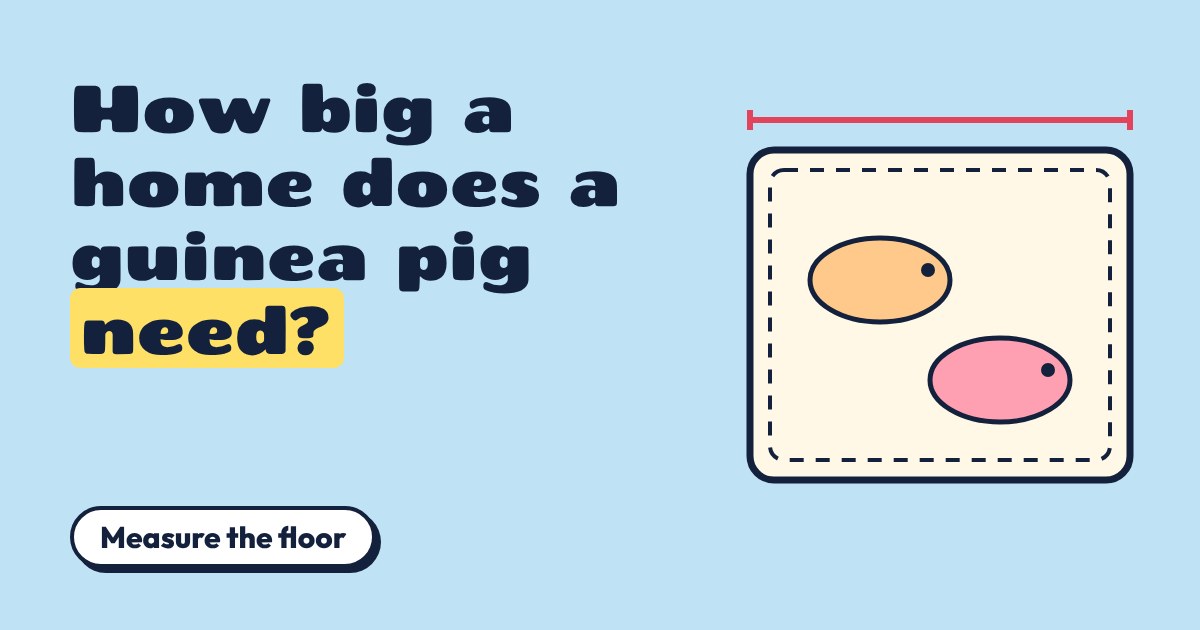
Space is the first thing a guinea pig asks for
Guinea pigs are small, but they are busy. They trot, hop, hide, graze and chase each other around the room all day. A cage that looks roomy to us can feel like a shoebox to them. The good news: you can check your set-up in about a minute with a tape measure.
First, one fact that shapes everything else. Guinea pigs get lonely and shouldn't be kept alone; the RSPCA says they are happiest in pairs. So the question is rarely "is this big enough for one?" but "is this big enough for two (or more) that need to move around each other?"
What the numbers mean
There is no single worldwide rule. Humane World for Animals gives minimum and preferred floor areas for one to four guinea pigs, and the figures above come from it. Other welfare groups in different countries publish their own figures, and they don't all agree. Where they differ, take the bigger number. Your guinea pigs will not complain about extra space.
The same source notes that a one-pig minimum is the same size as a pair's minimum, which is another reason to start with two. It also says sides should be at least about 30 cm high, and the RSPCA says the same: tall enough to stand fully up on their back legs.
Things that don't count
- Height isn't floor. Guinea pigs don't climb like hamsters or rats. Extra levels add little usable room.
- Wire floors and glass tanks. Humane World lists plastic tubs, glass aquariums and wire-floored cages as unsuitable, and a floor should be gentle on their feet.
- The label on the box. A product sold as a "guinea pig home" isn't automatically big enough. Measure the floor and compare it with the numbers above.
Beyond the floor plan
Size is only the start. A good home also has:
- Hiding places. The RSPCA suggests one more refuge than the number of guinea pigs. A cardboard box with two doorways works as well as a bought house.
- Soft, dry bedding about 5–8 cm deep (Humane World suggests paper-based bedding and avoiding cedar and pine shavings) with hay always available.
- A calm spot indoors, away from draughts, direct heat, loud noise and anything that could frighten them. Humane World advises roughly 18–24 °C.
- Daily time out of the enclosure, in a safe, pet-proofed area with other animals shut away.
Measure the floor, not the height: for two guinea pigs, aim for well over 0.70 m², then give them somewhere to hide.
When to ask a vet or rescue
If a guinea pig is hiding all the time, fighting with its companion, losing weight or has sore feet, a bigger home may help, but ask a vet to check them first. Rescues can also help you pair compatible guinea pigs. Please adopt from a rescue or shelter before looking elsewhere.