Is your hamster's home big enough? Check the floor, bedding and wheel
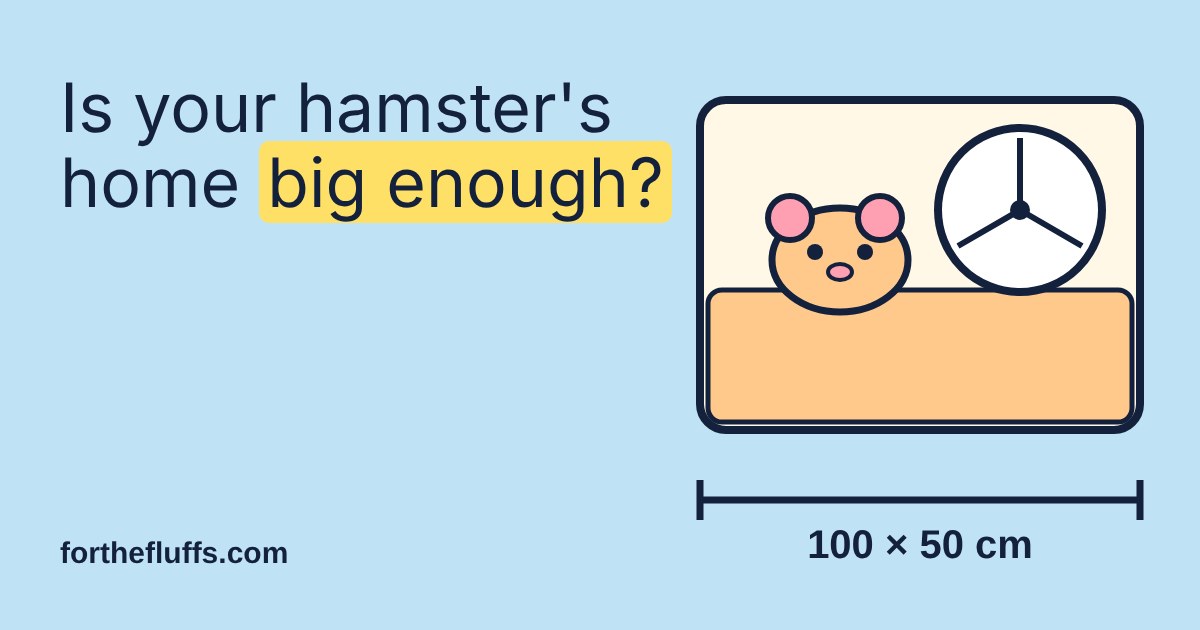
Is your hamster's home big enough? Vets and welfare charities agree on the basics: at least 100 × 50 cm of floor, deep digging bedding and a wheel big enough that the back stays flat.
Pick your hamster type, type in your measurements and get a quick checklist showing where your setup is good and where it falls short. We also explain why the numbers are so big, where sources differ, and when to ask a vet.
A hamster's home is a big job
Hamsters look tiny, so a small cage seems fine. It isn't. In the wild a hamster covers a lot of ground each night and digs long burrows. A home that's too small leaves it nowhere to run, dig or hide, and that's when you see bar-chewing and endless pacing.
Vets and welfare charities now give clear numbers for a good home. Use the checker below to compare yours with them. Measure the floor space inside the cage, the digging bedding from the base up, and the wheel across its running surface.
Why the numbers are so big
Floor space. Blue Cross says no smaller than 100 × 50 cm of floor and about 50 cm tall. The Veterinary Association for Animal Welfare, quoted by PDSA, gives the same 100 × 50 cm. Many cages on sale are smaller than this, so measure before you trust the label.
Digging depth. Hamsters are burrowers. Blue Cross asks for at least 20 cm of digging bedding and PDSA suggests about 25 cm. Deep bedding also lets your hamster make a nest and a food store, which are natural behaviours.
The wheel. A hamster can run kilometres in a night. On a wheel that is too small its back bends upwards, which is uncomfortable and may cause long-term back problems. The sources differ a little: for a Syrian, one hamster-welfare group says at least 27 cm, Blue Cross says 27–32 cm and PDSA says 30 cm. For dwarf hamsters the range is about 20–25 cm. The checker uses the cautious lower figure, so a pass means "big enough", not "perfect". If you're between sizes, pick the bigger wheel. Also look for a solid running surface with no gaps or rungs, so little feet can't get caught.
One hamster, one home. Syrian and Chinese hamsters live alone and will fight if kept together.
Right place, right temperature
Put the home somewhere quiet, away from drafts, direct sun and the sound of a TV. Hamsters sleep through the day, so a bedroom shared with a night owl can be a noisy place. PDSA suggests a steady 18–21°C. Offer more than one hiding place, such as a few plain cardboard boxes or ceramic hides, and a few chew-safe sticks and tunnels.
Skip hamster balls. The RSPCA has welfare concerns about them, and a wheel in a roomy home gives your hamster all the running it needs.
What to look for
- A floor of at least 100 × 50 cm, with room for deep bedding. Check the cage's inside measurements, not the box.
- A deep base or enclosure that holds 20 cm or more of bedding without spilling.
- A wheel sized to your hamster's type, with a solid running surface.
- Several hiding places, and a quiet, steady-temperature spot.
If your hamster is limping, losing weight, has a swollen face, or just doesn't seem right, ask a vet who sees small pets. Don't wait and see.