Dogs ·
How long can a dog be left alone? Plan your day and build the ladder
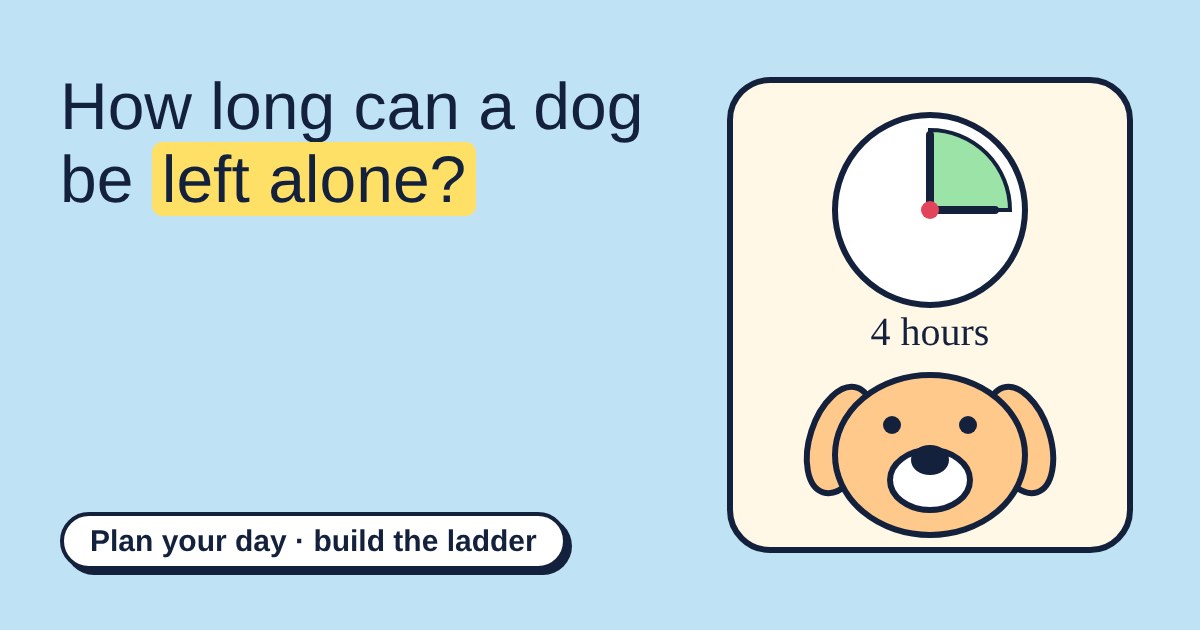
Most dogs will be home alone sometimes, and the PDSA and RSPCA both suggest no more than about four hours at a time for an adult dog. Puppies need less, and every dog is different.
Use the planner to check your day, then learn the slow, reward-based ladder that teaches a dog that being alone is safe, plus the signs that mean it is time to call your vet.
The four-hour rule, and why it is only a start
Most dog owners go out to work, shop or see friends, so the question is never whether a dog will be alone, but for how long and how ready they are. The PDSA and the RSPCA both suggest that adult dogs should not be left alone for more than about four hours at a time. That gives them room for exercise, a toilet break and company.
Four hours is a ceiling, not a target. Every dog is different. Very young puppies need less, and some dogs are upset after just a few minutes because nobody ever taught them that being alone is safe. That teaching is a skill, and it is built slowly.
Teach it like a ladder
Dogs are social animals. Being alone is something they learn to be calm about, rather than something they simply know. Both the PDSA and the RSPCA describe the same kind-and-slow approach. Practise each rung until your dog is relaxed, then move up. If your dog gets worried, go back one rung. That is not failing, it is how the method works.
- Settle on a bed or mat while you are in the room. Reward calm, quiet behaviour.
- Move a few steps away, come back and reward.
- Step out of the room for a few seconds, then minutes, in different lengths so it is not predictable.
- Go through the door and come back. Then close it and come back.
- Short trips out of the house. Build slowly. The RSPCA notes that once a dog is comfortable alone for about an hour, longer periods are usually more manageable.
The golden rule: always stay under the point where your dog starts to get worried.
Before you leave
A tired, comfortable dog finds it easier to settle. The RSPCA suggests a walk that finishes about half an hour before you go, a small meal, and a toilet break. Offer something safe to do, such as a stuffed chew toy or a treat puzzle, and take it away when you return. Make leaving and coming home calm and low-key rather than a big event, so neither feels dramatic.
What not to do
Never shout at or punish a dog for a mess, chewing or barking that happened while you were out. They cannot link it to what they did hours ago, and being scared makes worry worse. If your dog is already worried, long stretches alone can make it worse, so arrange cover while you train.
Signs your dog is not coping
The RSPCA lists barking, howling, toileting indoors and chewing or other destructive behaviour. Quieter signs are trembling, pacing and whining. The RSPCA suggests filming your dog while you are out, because some dogs look calm to the neighbours but are distressed. Neighbour complaints about noise can be a clue too.
If you see these signs, talk to your vet first. The PDSA advises that pain or a medical problem should be ruled out, and a vet can refer you to an accredited behaviourist if needed. Severe cases need professional help, not just home practice. Please do not try to diagnose it yourself.
What to look for
- Short, slow steps that your dog finishes happily, rather than leaps you hope they will cope with.
- A plan for the middle of the day if your day away is longer than about four hours.
- A safe, comfortable space at a pleasant temperature with water.
- Reward-based methods only. Kind training builds confidence.
Sources
- PDSA: Preventing separation anxiety
- PDSA: How to help your dog be comfortable with time alone
- RSPCA: Learning to be left alone
Advice differs a little between organisations and countries, and every dog is an individual. If you are worried about your dog, ask your vet.