When can a puppy meet the world? Build a socialisation checklist
Your puppy's brain is most open to new things in the first few months, so what it meets calmly now tends to feel normal later. But vaccinations mean some places are off limits for a while.
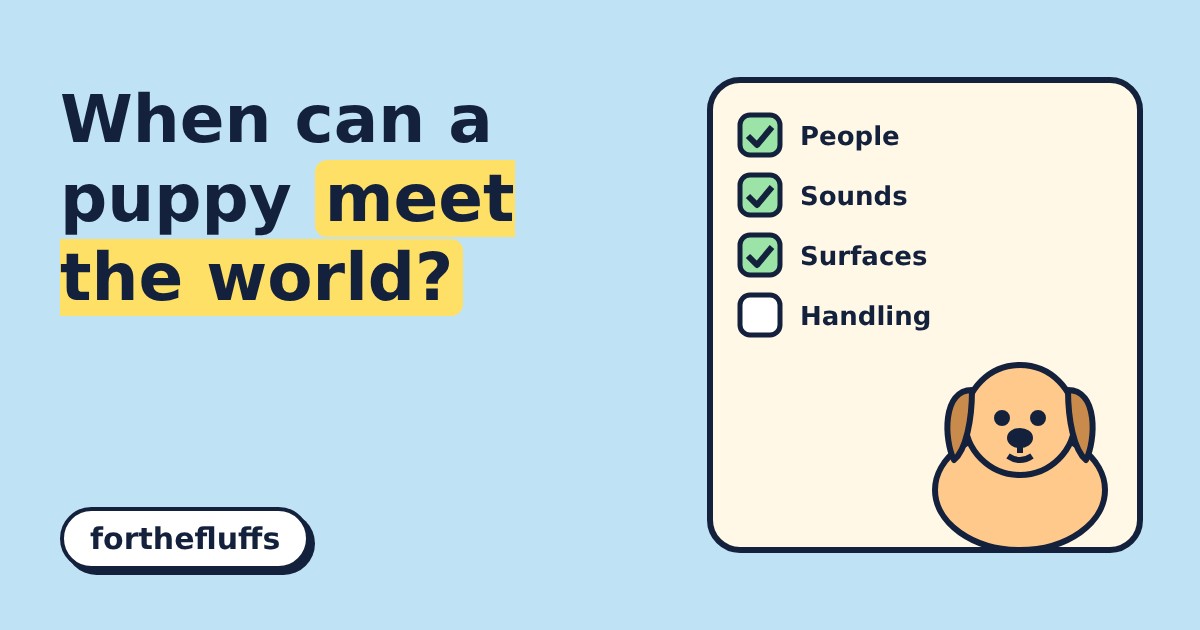
Build a checklist of 20 everyday experiences, tick them off as your puppy meets them calmly, and see how much of the early window is left. Always ask your vet what is safe for your puppy.
The window that won't wait
A young puppy's brain is built to soak up the world. In the first few months, things a puppy meets calmly (a vacuum, a bearded man, a bus, a nail clipper) tend to become "normal". Things it meets only after that window narrows are more likely to feel scary. Vets and welfare groups call this socialisation: not "meeting lots of dogs", but learning that everyday life is safe.
The sources give slightly different edges for the window. The PDSA describes it as roughly 4 to 12 weeks, the RSPCA as about 4 to 16 weeks, and the American Veterinary Society of Animal Behavior (AVSAB) points to the first three months or so. They agree on the big picture: the early weeks matter most, and the window closes gradually rather than slamming shut. Most puppies join their new home at around 8 weeks, so you have a few precious weeks to use well.
What about vaccinations?
This is the part that worries new owners most. Your puppy is not fully protected until its vaccine course is done, so some places and some dogs are off limits for a while. Yet waiting at home until that day risks missing much of the window. The AVSAB position is that puppies can start well-run classes from about 7 to 8 weeks old after at least one round of vaccines, because behaviour problems are a bigger risk to young dogs than infectious disease. UK welfare charities such as the PDSA take a more cautious line: carry your puppy to see the world, visit private gardens that no unvaccinated dog has used, and meet only fully vaccinated, friendly adult dogs.
Which rules fit your area depends on local disease risk. Ask your vet when your puppy can safely go where, and follow that advice.
Build your puppy's checklist
Tap an experience once your puppy has met it calmly (relaxed body, happy to eat a treat, or curious). If your puppy was worried, don't tap it: go back a step and make it easier. Set your puppy's age to see how much time is left.
How to do each one well
- Go slowly. Start with a quiet row of shops before a busy high street. A puppy that freezes, hides, trembles, or refuses a treat is saying "too much". Calmly add distance or take a break. Never force a puppy closer to what scares it.
- Pair new things with treats. This is reward-based training: the vacuum appears, a tiny treat appears. Soon the vacuum predicts good things.
- Quality beats quantity. Letting your puppy watch the world from your arms is real socialisation. Greeting every dog and person is not the goal, and a rough or pushy greeting can teach the wrong lesson.
- Choose dog friends carefully. Meet calm, friendly, fully vaccinated adult dogs that you know. Well-run puppy classes (rewards only, small groups, vaccination checks) are a great option.
- Keep naps sacred. Young puppies need a lot of sleep. A tired puppy copes badly with new things.
When to ask for help
If your puppy seems frightened of many things, growls or snaps when scared, or you are unsure how it is coping, speak to your vet. They can check for health causes and point you to a qualified, reward-based behaviourist. Avoid anyone who suggests punishment, shouting, or "flooding" your puppy with the scary thing.