Reptiles ·
How often should you replace a reptile's UVB lamp? Check the lamp before it fades
A UVB lamp keeps shining just as brightly to your eyes long after it has stopped giving your reptile much UVB. This guide explains why, what the vets and welfare groups say about replacing lamps, and why glass, distance and hours matter as much as age.
Use the lamp check-up to enter how long your lamp has been fitted, what the maker says and what sits in the way, and get a replace-by date with a quick checklist. Always follow your lamp's instructions, and ask a reptile vet if your pet seems unwell.
A lamp that still glows can be worn out
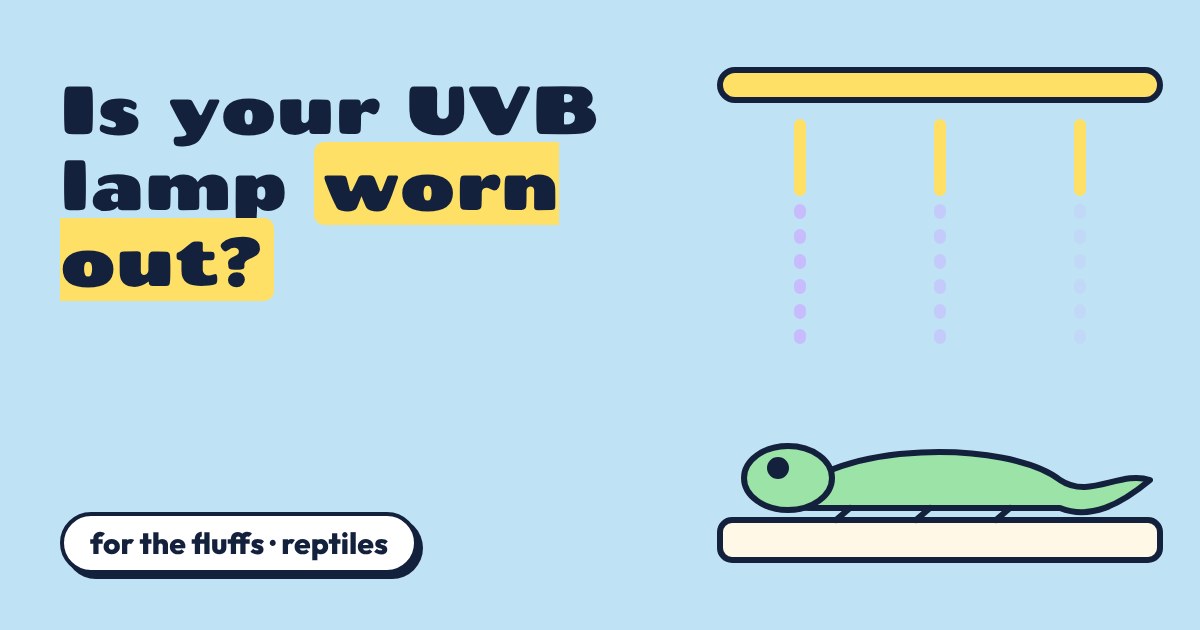
Many reptiles that bask in the sun, such as bearded dragons, need UVB light to make vitamin D3 in their skin. In a home, that usually comes from a special UVB lamp. Here is the catch: a UVB lamp slowly makes less UVB as it ages, but it keeps shining just as brightly to your eyes. The vet site VCA Animal Hospitals puts it plainly: the UV output of a bulb decreases with age, so an old bulb can still light up while giving your reptile less of what it is there for.
So you can't judge a lamp by looking at it. You judge it by its age, by how it is set up, and, if you want to be sure, by measuring.
How long does a UVB lamp last?
Sources give slightly different answers, so here is what each says. VCA suggests replacing bulbs every 9 to 12 months or as the maker directs (its own page summary says six months, so even one source is not consistent). The RSPCA and the Royal Veterinary College (RVC) both say to follow the manufacturer's instructions, and the RSPCA adds that you can check output with a UV index (UVI) meter held at your animal's level. Lamp types differ, so the number on your box wins. If you can't find it, the cautious choice is to go with the shorter end of the range.
Whatever the number is, write the fitting date on the lamp's base with a marker, or put a reminder in your phone. That is the single most useful habit.
The other things that make a lamp work (or not)
- Hours. The RSPCA suggests a plug-in timer with about 12 hours on and 12 hours off, and the RVC likewise says around 12 hours a day. Check your species' care sheet, because needs differ.
- Nothing in the way. Glass and plastic block UVB, according to VCA. Arcadia, a UVB lamp maker, says its UVI recommendations assume the lamp is fitted inside the enclosure with a suitable reflector. A mesh lid can reduce the amount that reaches the animal, which is where a meter earns its keep.
- Distance. Follow the maker's chart for your lamp and species. Too close can harm eyes and skin (VCA), and too far gives less UVB than you think. The 30 cm figure you may see online is a rule for some lamps, not all.
- A shady spot. Your reptile should be able to step out of the UVB. The RSPCA bearded dragon sheet describes UVI in the basking zone dropping to zero in shade.
Measuring beats guessing
A UVI meter shows the UV index at the spot where your animal sits. Targets depend on the species: the RSPCA gives a basking-zone UVI of 3.0 to 5.0 for bearded dragons, while Arcadia recommends a UVI of 2 to 3 for leopard geckos. Use the figure for your species, and take the reading at the animal's head or back height, not at the lamp.
When to ask a vet
A new lamp is not a treatment. If your reptile seems unwell, for example it is sluggish, eating less, or its limbs or jaw look swollen or soft, call a vet who sees reptiles instead of changing bulbs and waiting. The RVC recommends a health check for pet reptiles every year, which is also a good moment to show them your lighting setup and lamp dates.
Write the fitting date on the lamp, follow the maker's replacement date, and measure if you can: a lamp that glows is not proof that it still gives UVB.