Reptiles ·
How warm should a leopard gecko's tank be? Check the warm end, cool end and night
A leopard gecko needs a warm end, a cool end and a gentle drop at night, not one single number. This guide gives you a heat checker: type in the readings from your thermometers and see what to adjust, from the warm end and cool end to the night-time room and your heat source.
You'll also learn why hot rocks are best avoided, why every heat source needs a thermostat, and where the RSPCA and a veterinary sheet differ.
Why a gecko needs two temperatures
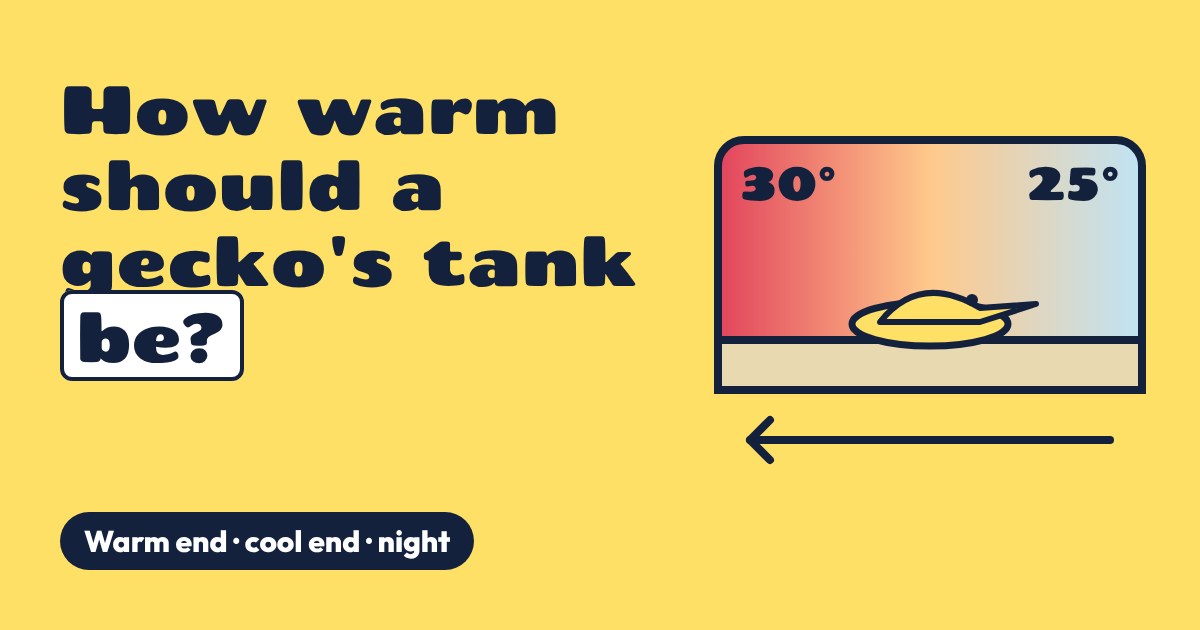
A leopard gecko is a cold-blooded desert lizard. It can't make its own body heat, so it moves between a warm spot and a cooler spot to get its temperature right, a bit like you moving between sun and shade. That is why one number is never enough: the tank needs a warm end, a cool end and a gentle drop at night.
Too cold and a gecko digests slowly and gets sluggish. Too hot and there is nowhere to cool off. Type in what your thermometers say and the checker below shows what to adjust.
The numbers, in plain words
- Warm end: about 28–30°C according to the RSPCA. A university veterinary sheet describes a heat mat keeping the warm end around 30–35°C. When sources differ, the lower, gentler end is the safer start.
- Cool end: about 24–26°C in the RSPCA sheet and around 24°C in the veterinary one.
- Night: the RSPCA says turn the heat off at night, unless the room falls below about 18°C. Then use gentle background heat that gives no light, controlled by a thermostat.
These are surface readings where your gecko actually sits, not the air at the top of the tank. Geckos take in a lot of heat through their bellies from warm ground, so the floor matters most.
Heat sources: what is safe
A heat mat on one side of the tank is the usual choice and is recommended by veterinary care sheets. A ceramic or basking lamp can work too, especially in taller tanks. Whichever you use:
- Use a thermostat. It keeps the temperature steady. The RSPCA says one is needed with all heat sources, and still advises checking daily with a thermometer, because thermostats are not always accurate.
- Skip hot rocks. Veterinary sources warn against them because they can get dangerously hot.
- Guard lamps. Keep bulbs out of reach so nobody gets burned.
Measure the floor, not the air, and keep a warm end, a cool end and a quiet night.
Check it regularly
Look at the readings at the same time each day for the first week, then every few days. Seasons change your room temperature, so a tank that was perfect in July may need a tweak in January. A very cold or very hot gecko, a gecko that stops eating or any odd behaviour is a reason to call a reptile vet. Don't try to fix health problems with heat alone.
Lighting and UVB are a separate topic: the RSPCA sheet covers it, and so does a vet if you are unsure.
Sources
- RSPCA: Leopard gecko care sheet (warm and cool ends, night, thermostats)
- University of Liverpool veterinary science: Leopard gecko sheet (heat mats, hot rock warning)