Birds ·
How big a cage does a budgie need? Measure yours against the wingspan rule
How big a cage does a budgie really need? The RSPCA sizes it by wingspan: at least twice the wingspan in height, width and depth for a group of budgies, with a little extra for every bird beyond two.
Enter your birds and your cage's measurements, and get a pass or fail on each side, a bar-gap check and a comparison with the vet-manual minimum. It also covers why width beats height, where to place the cage and why time out of it still matters. Sources are the RSPCA and veterinary guides.
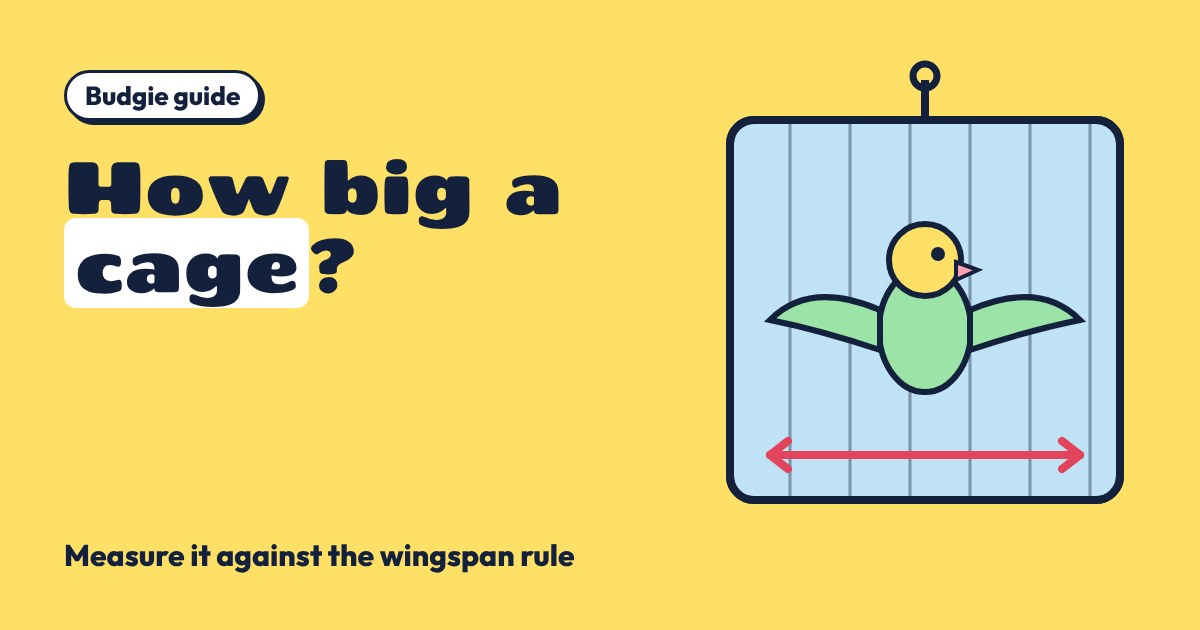
A budgie's cage is not just a bedroom. For many birds it is where they eat, sleep, climb and spend most of the day. The question is how big is big enough, and the honest answer is: bigger than most shop cages. This guide gives you a rule from a welfare charity, shows you how your own cage measures up, and explains why shape matters as much as size.
Why wingspan is the measuring stick
Budgies are flying birds. A wild budgerigar is about 18 cm long but its wings stretch to roughly 30 cm tip to tip, and most pet budgies are close to that size. The RSPCA sizes cages by wingspan rather than by a fixed number of centimetres, because a bird that cannot flap its wings fully is a bird that cannot behave normally.
Its rule of thumb: a cage where birds spend most of the day should be at least twice the bird's wingspan in height, width and depth. A group of budgies, cockatiels or lovebirds in a cage should also get at least twice the largest bird's wingspan. If your birds spend most of the day outside the cage, the RSPCA says at least one and a half times the wingspan. For more than two birds, it adds a bit more space for each extra bird (5% per bird for birds under 50 g, which includes budgies).
Check your cage
Twice the wingspan in every direction is the floor, not the goal. Choose the biggest rectangular cage you can fit.
Shape and bars matter
Budgies fly sideways far more than they fly up and down, so a wide, deep cage beats a tall, narrow one of the same volume. One avian care guide calls 14 inches (about 35 cm) a bit narrow for a cage and says width and depth matter more than height. So when you compare cages, look at width and depth first.
Bar spacing is about safety. The Merck Veterinary Manual lists 0.5 inch (about 1.3 cm) for budgies and other small birds, and one UK guide says bars should be not much more than 1 cm apart. Anything wider can let a head through. Horizontal bars help a budgie climb the sides, which is a bonus.
The cage is only part of the day
The RSPCA says pet birds need at least six hours outside their cage every day, with space to fly freely and safely indoors. A big cage does not replace that time. Before the door opens, close windows and doors, cover or screen big mirrors and windows, switch off ceiling fans, and keep the bird out of the kitchen. Overheated non-stick (PTFE) pans release fumes that can be fatal to birds, sometimes with no warning signs. The RSPCA advises against wing clipping and suggests training, a secure aviary and enrichment instead.
Budgies are social birds that live in flocks, and the RSPCA lists them among species that live in groups. If you have only one bird, ask a vet or rescue about whether a companion would suit it before adding one, and give extra space for the extra bird.
Where to put the cage
- Put the back of the cage against a solid wall, so the bird feels safe, and cover the top with a cloth.
- Keep it away from radiators, fires, stoves, draughts and the kitchen.
- Use natural wooden perches of different widths and angles, with enough for every bird to perch at once. Do not put them above food and water.
- Put the cage on something stable that children, dogs or a vacuum cleaner cannot knock over.
What to look for
- Size: at least twice the wingspan in every direction, and wider than it is tall.
- Bars about 1 to 1.3 cm apart, with a secure door catch that a clever beak cannot open.
- Enough clear space after perches and toys are in, so the birds can flap and hop without bumping each other.
- Safe materials with no flaking paint or rust, and a tray that slides out for easy cleaning.
If a bird seems unwell, is plucking its feathers or is sitting fluffed up and quiet, that is a job for a vet who sees birds, not for a bigger cage.
Sources
- RSPCA: Housing and environments for pet birds
- RSPCA: Living with other birds
- RSPCA: How to fly pet birds safely
- Merck Veterinary Manual: Minimum cage size and bar spacing
- Lafeber: Ask Lafeber on cage size
- Omlet: Budgie cage design
- Budgerigar: size and wingspan
- Veterinary client guide: PTFE poisoning in birds