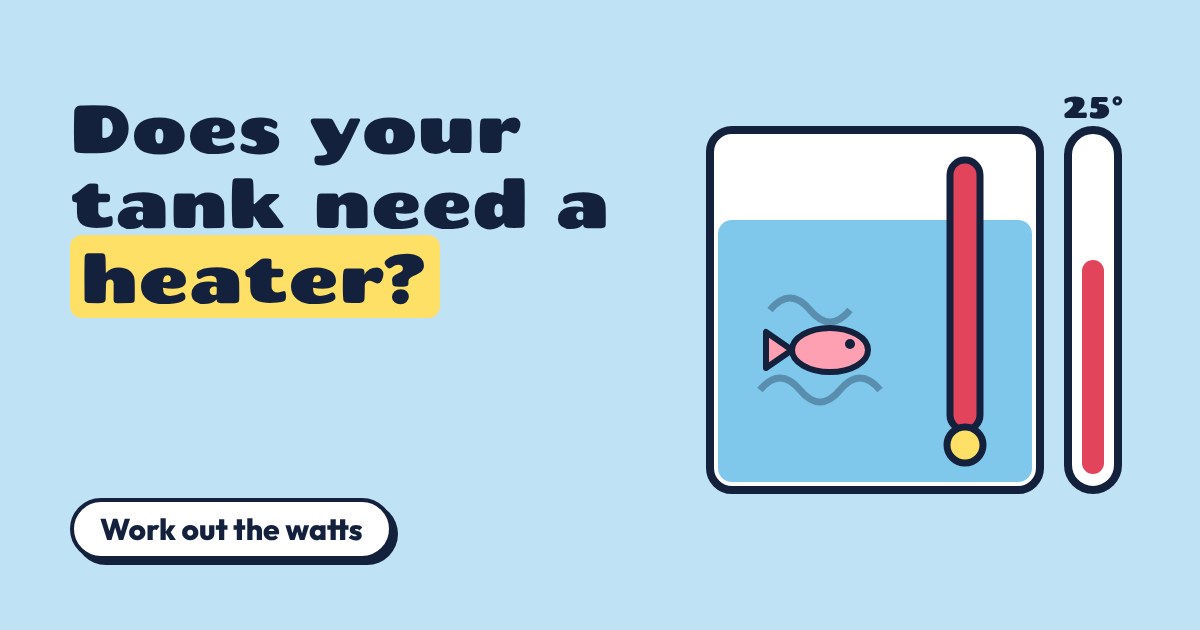
Does your tank need a heater?
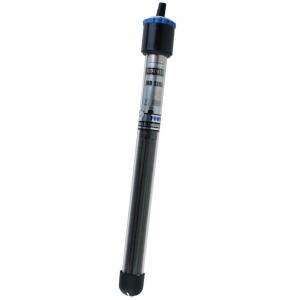
If your fish come from warm places, yes. Most tropical freshwater fish do best at about 24–26 °C, and a normal living room is colder than that and swings up and down between day and night. Welfare groups such as the RSPCA say a submersible aquarium heater is the way to hold a steady, suitable temperature, because room heat and lamps are too unreliable.
The next question is how many watts. Too small and the heater runs flat out and still can't keep up on a cold night. Too big and a stuck or faulty heater can overheat the tank faster. Try the calculator, then read why it works.
Why it works
A heater only has to cover the gap between the room and the water. A tank in a 22 °C room aiming for 25 °C has a 3-degree gap. A tank in a 14 °C hallway aiming for 25 °C has an 11-degree gap and loses heat to the air all night.
That's why guides give a range, not one number. A common rule for a normally heated room is about 1 watt per litre. Cold spots such as garages, conservatories or draughty rooms need roughly 1.5 to 2 watts per litre. The calculator above uses those bands: up to 5 °C gap is 1 W per litre, 6 to 10 °C is 1.5 W, and more than that is 2 W.
US guides give a similar rule in gallons (about 5 watts per gallon for a 10 °F rise, with a lid). Sources differ a little, so treat your result as a starting point and round up to the next heater size on the box.
Two small heaters beat one big one
On bigger tanks, split the total. For a tank that needs 200 watts, two 100-watt heaters are a better idea than one 200-watt heater. If one fails, the other still keeps the water from getting cold, and a single faulty heater can't overheat the whole tank on its own. Put them at opposite ends so the warmth spreads.
Check it, don't trust the dial
The number on the heater is a setting, not a reading. A separate thermometer tells you the real temperature.
Put the thermometer at the far end of the tank from the heater, so you see whether the warmth really reaches the whole tank. Look at it every day. A heater that is stuck on is a serious fault, and a fish can be in trouble well before you notice.
Two safety habits matter most. Unplug the heater before a water change: if it sits in the air while hot, the glass can crack or the element can burn out. And keep it fully underwater as the maker says. Also, let new water come to room temperature before it goes in, so the tank doesn't get a sudden chill.
Which fish don't need one?
Coldwater fish kept indoors in a normal room, such as goldfish, generally manage without a heater, as long as the room doesn't get unusually cold. Some tropical species want it warmer than 25 °C (certain cichlids and discus like it closer to 28–29 °C). Always check the range for your own species. If your fish look unwell, are gasping or clamped at the surface, ask a vet who treats fish rather than guessing.
What to look for
- The right wattage for your tank, with the room's coldest night in mind, rounded up a size. On big tanks, plan two heaters.
- A heater made to stay underwater and an adjustable thermostat, so you can set 24–26 °C rather than guess.
- A separate thermometer, placed far from the heater and easy to read at a glance.
Sources