How often should you change your fish tank's water? Plan the weekly change
Fish make waste all day, and a weekly water change is how you keep it from building up. About 25% a week is the common starting point, but your stocking, feeding and tap water change the answer.
Use the planner to turn that into litres for your tank, check your nitrate test against your tap water, and follow the gentle step-by-step so the change never shocks your fish.
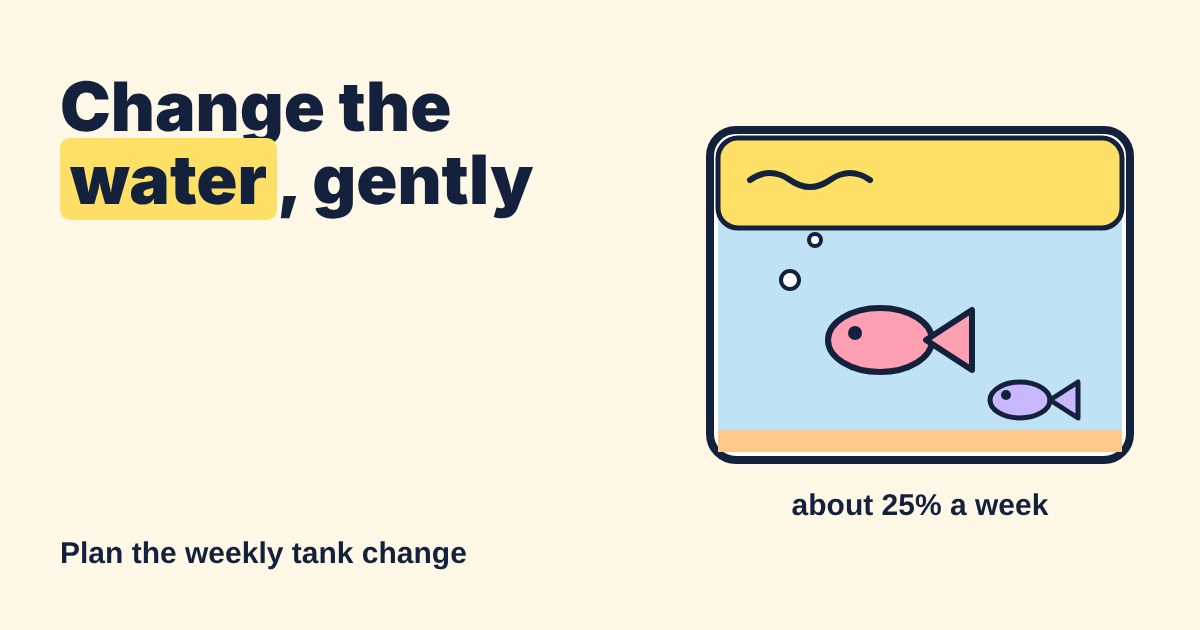
Fish live in their own wastewater. Every meal turns into waste, and in a healthy tank that waste is broken down in stages until it ends up as nitrate, a much milder substance that simply builds up over the days. Water changes are how you take it out again. Too little and the nitrate creeps up; too much, too fast, and you can stress the fish with a sudden swing in temperature or water chemistry. The sweet spot is a steady, boring routine.
A weekly change is the usual starting point
Most aquarium keepers and fish-keeping sources land on about 25% of the water once a week as a baseline for a freshwater community tank. Practical Fishkeeping says it works well for most people but depends on the tank. Fishkeeper adds that tanks with lots of messy fish (goldfish and big cichlids are the classic examples) need more, and that some set-ups, such as Tanganyikan cichlid or reef tanks, do better with small changes of about 10% to keep conditions steady.
Use the planner below to turn that into litres for your own tank. It is a rule of thumb, not a prescription: your stocking, feeding and plants all change the answer.
Change a little water on a steady schedule, and let your nitrate test, not guesswork, tell you whether it is enough.
How to do the change gently
- Unplug the heater and filter before the water level drops, so the heater is never left dry.
- Take the water out with a gravel siphon, hovering over the substrate to lift loose waste. Don't scrub everything clean; a spotless tank has also lost its helpful bacteria.
- Treat the new water. Tap water usually contains chlorine or chloramine, which can harm fish and the bacteria in the filter. Use a water conditioner that says it treats both, and dose it for the volume of new water using the label.
- Match the temperature of the new water to the tank, to within a few degrees. A thermometer is more reliable than a finger.
- Pour or pump in slowly, aiming at a plate or your hand so the gravel and plants are not blasted.
- Switch the heater and filter back on.
The filter is not part of the same job
Filter sponges and ceramic media hold the bacteria that keep the water safe. Fishkeeper advises rinsing biological media in a bucket of old tank water when flow slows, never in tap water that contains chlorine, and cleaning only part of it at a time. A monthly rinse alongside that week's water change suits many tanks.
When a water change is not the answer
If the tank is new or you have added fish recently, your test kit may show ammonia or nitrite instead of just nitrate. That points to a cycle that has not settled, which is a different problem from routine upkeep. Fish gasping at the surface, clamped fins or sudden deaths need an aquatic vet or a good aquatic shop, not guesswork. We do not give medicine doses or diagnoses.
If your tap water already has high nitrate, the water change adds some back in. Test it, and ask a local aquatic shop about options.
What to look for
- A liquid test kit that covers ammonia, nitrite and nitrate.
- A conditioner that states it treats chlorine and chloramine, with dosing for the volume of new water.
- A gravel siphon with a hose long enough to reach a bucket or drain.
- A clean bucket used only for the tank, with no soap residue.
Sources
- Practical Fishkeeping: How often should I change my water?
- Fishkeeper: How often and how much to change water, and cleaning the filter
- Fishkeeper: Getting rid of nitrate
- Aquarium Source: Making tap water fish-safe
Sources differ on exact schedules, and the right amount depends on your fish, plants and feeding, so treat the numbers as a starting point.