What size crate does your dog need? Measure and check the fit
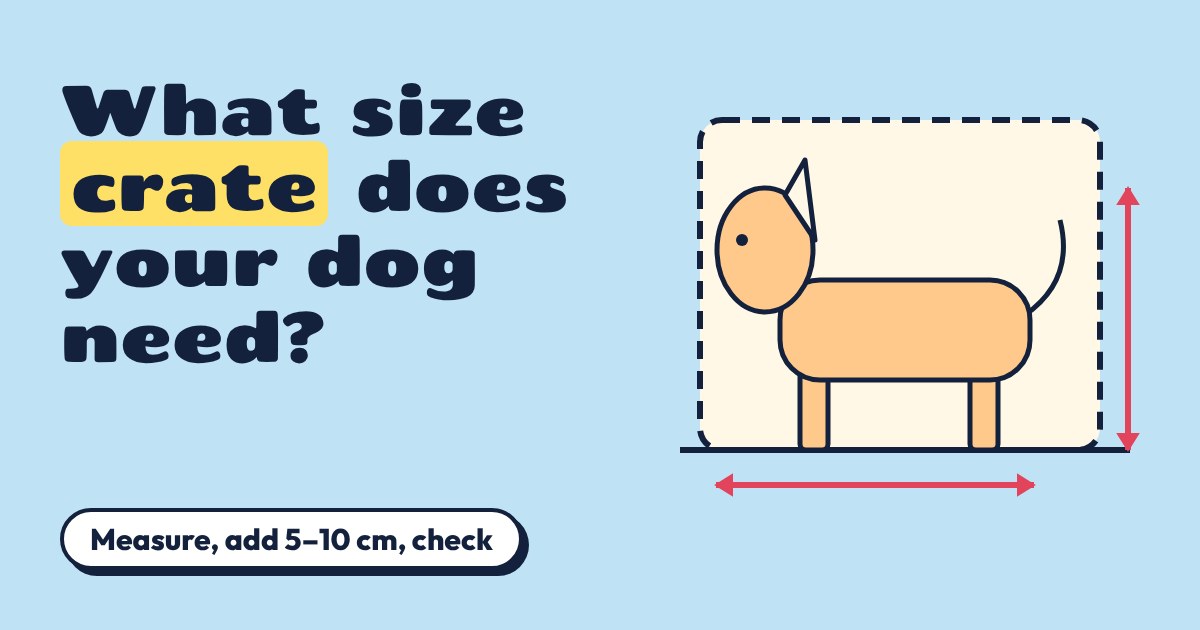
A dog crate should be big enough for your dog to stand up, turn around and lie down comfortably, but not so big that there is room for a toilet corner. Measure your dog's length and height, add a few centimetres, and check any crate against those numbers.
The calculator draws your dog inside the crate to scale, shows how to size for a growing puppy, and covers the reward-based way to make a crate a place your dog likes.
The one test that matters
A dog crate should be big enough for your dog to stand up, turn around and lie down comfortably. That is the rule welfare groups and vet schools keep coming back to. It sounds easy until you are looking at a shop listing that says "medium" and you have no idea whose medium it means.
So skip the label and use a tape measure. Two numbers are all you need, and the calculator below does the sums.
How to measure
Stand your dog on a flat floor and measure twice, because wriggly dogs give two different answers.
- Length: from the tip of the nose to the base of the tail. Leave the tail out.
- Height: from the floor to the top of the head or the tips of the ears, whichever is taller.
Add 5 to 10 cm to each (that is 2 to 4 inches) and you have the smallest crate interior that will work. A dog who sleeps stretched out, or who has a thick bed in there, will want the upper end.
Why not just go big?
A bigger crate is not a kinder crate. Vet-school and shelter guides both say a crate should not be large enough for a separate toilet corner, because dogs naturally avoid soiling where they sleep and a big space weakens that habit. A snug den also tends to feel safer than an echoing room.
Puppies: buy for the adult, block off the back
Puppies grow fast. The usual advice is to measure for the size they will be as an adult and use a divider to shrink the space for now. Ask the shelter or your vet for the expected adult size. If your puppy is a mixed breed, that is only an estimate, so re-measure every month or two.
Make it a place they choose
Size is only half of it. A crate works when your dog thinks it is a nice place to be, and that comes from rewards, not pressure.
- Start with the door open. Toss treats or a chew inside and let your dog wander in and out.
- Close the door for a few seconds only once they walk in happily, then open it before they fuss. Build up slowly.
- Never use the crate as punishment, and never push or shut a dog in. That teaches them to fear it.
- Take the collar off before leaving a dog alone in a crate, since tags and buckles can catch on the wires.
- Keep the crate out of direct sun and away from heat sources, and never leave a dog in a crate in a parked car.
How long is too long? Sources give different numbers: one shelter guide builds adults up to around eight hours with exercise and a midday break, while another gives puppies a ceiling that rises with age from about four hours at three months. Treat any number as a limit, not a target, and never as the plan for every day. Very young puppies need to go out far more often.
If your dog panics, drools, pants hard or tries to escape the crate, stop and ask your vet or a qualified reward-based trainer. A crate is not a fix for separation distress.
What to look for
- Inside measurements that clear your dog's length and height plus 5 to 10 cm.
- A divider if you are buying for a growing puppy.
- Good ventilation on several sides and a door that latches securely.
- A crash-tested or well-secured crate if it will travel in a car. A loose crate can be thrown about in a sudden stop.
Sources
- Humane Society for Hamilton County: Crate training (room to stand, turn and lie down; never punish; introducing the crate with treats)
- PAWS Chicago: Crate training (never as punishment; collar off; puppy time ceilings by age)
- UC Davis School of Veterinary Medicine: Crate training your puppy (no toilet corner; buy for adult size and block off the back)
- A pet retailer's crate size chart (measuring method, the 2 to 4 inch allowance and the weight chart; a retailer, so used for the measuring method only)